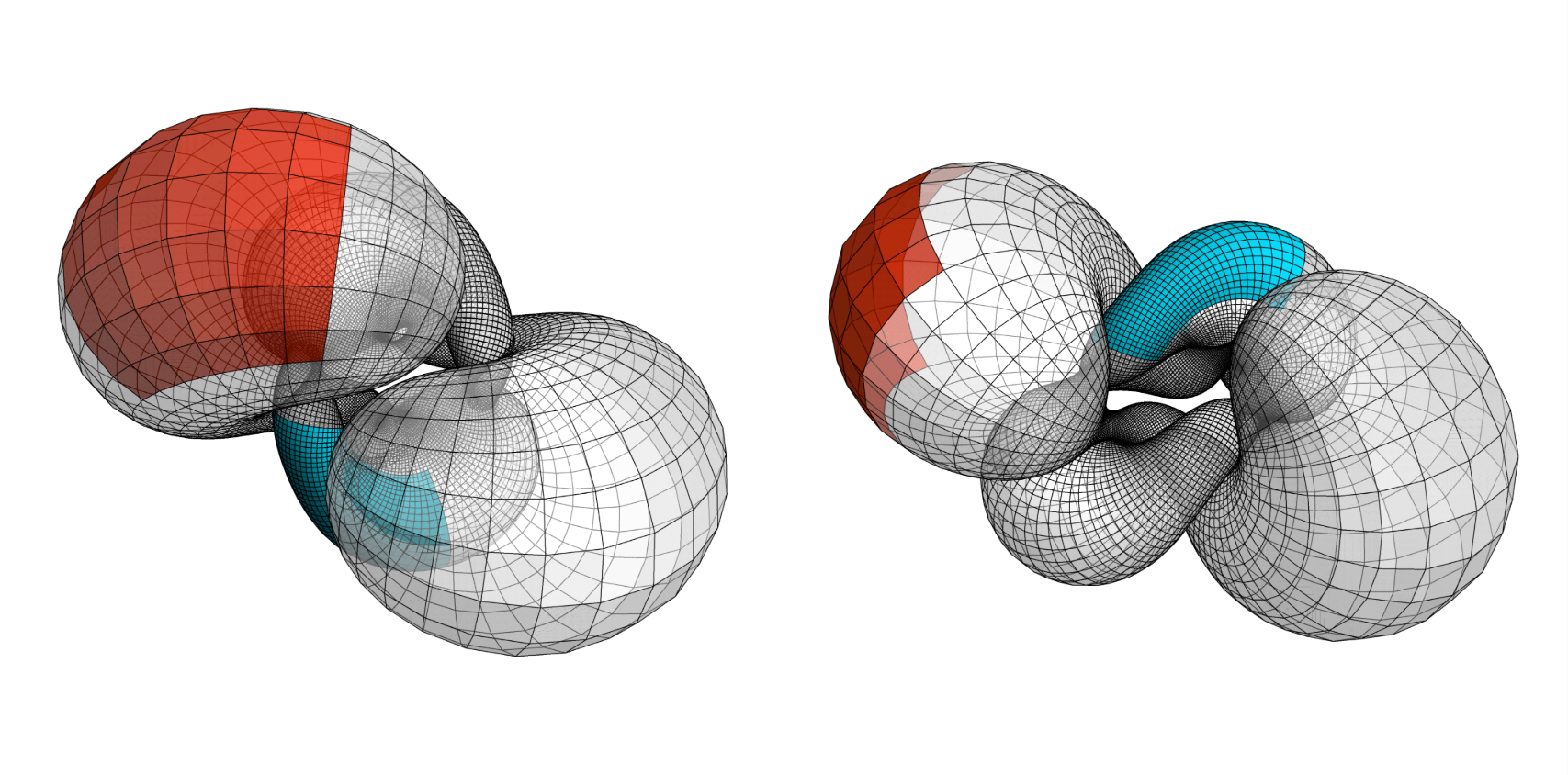
The article “Compact Bonnet Pairs: Isometric Tori with the Same Curvatures” by Assistant Professor Andrew Sageman-Furnas and his co-authors, Alexander I. Bobenko (TU Berlin) and Tim Hoffmann (TU Munich), appeared in Publications Mathématiques de l’IHÉS in October, 2025. This journal publishes on average eight articles per year, and is considered one of the most prestigious journals in mathematics.
The result settles an open question in geometry with a long history. In 1867, Bonnet investigated whether a surface in three-dimensional space can be uniquely determined by two geometric quantities: the metric (which defines how lengths are measured on the surface) and the mean curvature (which captures how the surface bends into space). While this is generically sufficient, Bonnet studied the exceptions. Fast-forward to 1981: Lawson and Tribuzy proved that a topological sphere is uniquely determined by its metric and mean curvature. For tori and higher-genus surfaces, however, they showed that these data can determine at most two distinct surfaces. The question about whether two such compact immersions can actually exist remained open until now.
Sageman-Furnas and his co-authors demonstrated that such non-uniqueness actually occurs: two distinct, smooth tori with the same metric and mean curvature do exist. An unusual aspect of their work is the use of high-precision computational experiments and new discrete theories to discover these shapes. These experimentally-found surfaces exhibited many surprising properties, which then were used to find and prove that the analogous smooth surfaces exist. The image above shows a pair of such smooth surfaces constructed by the authors, where the color indicates their correspondence by the mean-curvature preserving isometry.
- Categories: